

The Other Kind of Lonely—When the Office Echoes
You may have read my piece about the loneliness of working from home, the kind of quiet that swallows you up, where the office becomes not just a place to work, but a place to belong. But there’s another kind of lonely I can’t stop thinking about: the loneliness of empty space.
Let’s talk numbers. Say your office building is 40,000 square feet. These days, only 45 of you are coming in. Empty space isn’t free. Every square foot that sits unused is a lost opportunity, a silent cost. If utilization is low, simply redesigning the same oversized footprint is a bridge, not a strategy.
Ask yourself: how much office space do we own, and how much do we use? Is your office built for a world that no longer exists?
Right-sizing isn’t about shrinking for shrinking’s sake. It’s about matching the space to the actual attendance, to the way people really work, and to the dollars you’re really spending. The goal isn’t to gut your office of its soul, it’s to make every square foot count, for people and for budgets.
This isn’t just a facilities problem. It’s a leadership challenge. As we rethink the purpose of the office, we need to be honest about what we’re holding onto, and why. Are we designing for connection? For collaboration? Or are we clinging to the comfort of space simply because it’s what we’ve always done?
The world changed. Our workforce changed. If we want to create offices that people choose—not just tolerate—we have to design for reality, not nostalgia. That means letting go of the myth that bigger is always better. Instead, let’s right-size with intention and create spaces that are as dynamic as the people who use them.
Does the diagram look familiar?
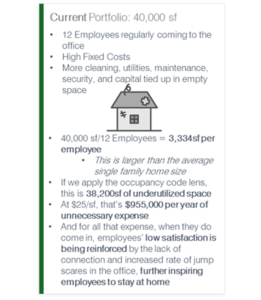
What if you flipped it to look like this:
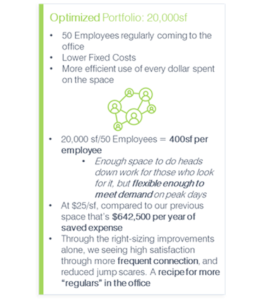
The right office isn’t about square footage. It’s about fit, the right size, the right energy, the right opportunity for people to connect, focus, and belong.
That’s the future we should be building for.