

I couldn’t help but wonder… are we designing our offices for the wrong kind of lonely?
That was the confession from one of my partners during our monthly Zoom call. She had spotted my backdrop and mentioned how lovely it looked — full disclosure: I was perched at a plastic picnic table outside my office building, which I have lovingly dubbed my “outdoor office.” She said she would have given anything to join me. And then, almost as an afterthought, she said it — working from home had become lonely. Isolating, even.
And just like that, I had a blog idea.
My first thought? Lonely? I haven’t had a quiet, lonely moment since my son came into the world 18 years ago. Most days, I would trade my entire designer handbag collection for five fleeting minutes of blissful solitude. But my second thought was more generous — maybe this is generational. She is younger than me, her children are younger, and her home is likely full of a very different kind of noise. The kind that makes an empty apartment feel even emptier once everyone is gone.
For her, the office wasn’t just a place to work. It was a place to feel like herself again. To be seen. To belong to something.
We talk endlessly about RTO mandates, productivity metrics, and the great tug-of-war between executives and employees over where work should happen. But that conversation with my partner stopped me in my track. Because what if, in all of our very important discussions about the workplace, we have been missing the most human piece of the puzzle?
Social connection.
Not a ping-pong table. Not a cold brew on tap. Real, honest, I-see-you human connection. The kind that makes a commute feel worth it. The kind that reminds you that you are part of something bigger than your living room.
When we design spaces, are we making room for people to actually find each other? To linger a little longer, to stumble into a conversation that turns into a collaboration, to form the kind of relationships that make Monday morning feel less like a punishment?
And it is not one-size-fits-all. Different generations socialize differently. Different personalities need different kinds of spaces to open up. Introverts and extroverts, Gen Z and Boomers, the person who needs a corner to decompress and the person who thrives in the middle of the chaos — they all deserve a workplace that was designed with them in mind.
Bringing people back to the office is not just a policy decision. It is a design challenge. And if we want people to actually want to come back — not just comply, but genuinely choose it — we have to give them something the home office cannot: each other.
Now, I will be the first to admit — I am the open floor plan’s worst nightmare. I am chatty. I am nosy. I have been known to derail an entire afternoon with one good story. But even I, the self-proclaimed office menace, need a quiet corner sometimes. When I am deep in thought, when the deadline is real, and the ideas are finally flowing, I do not want the noise. I want to disappear in order to focus.
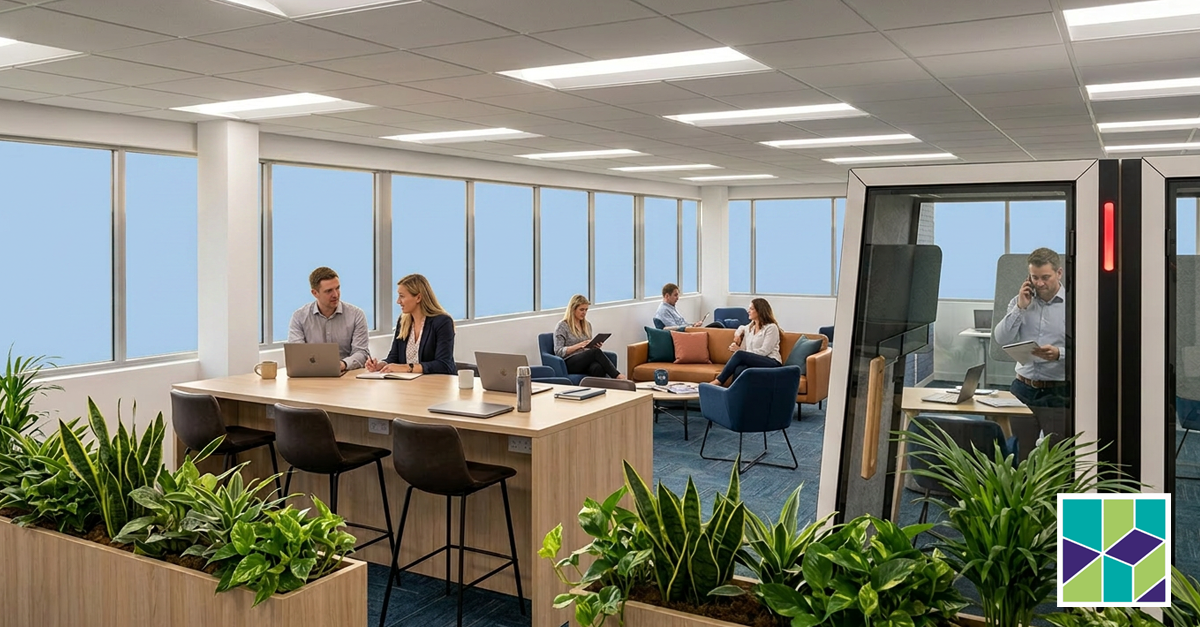
And that is exactly the point. The best workplaces are neither loud nor quiet. They are both. They flex. They breathe. They make space for the lonely and the overstimulated, for the connector and the concentrator, for the person who came in desperate for a connection and the one who came in desperate for silence.
Designing for the employee experience means designing for all of it — the messy, beautiful, complicated, deeply human need to sometimes be together, and sometimes be gloriously, peacefully alone.
And if we get that right? The commute practically sells itself.