
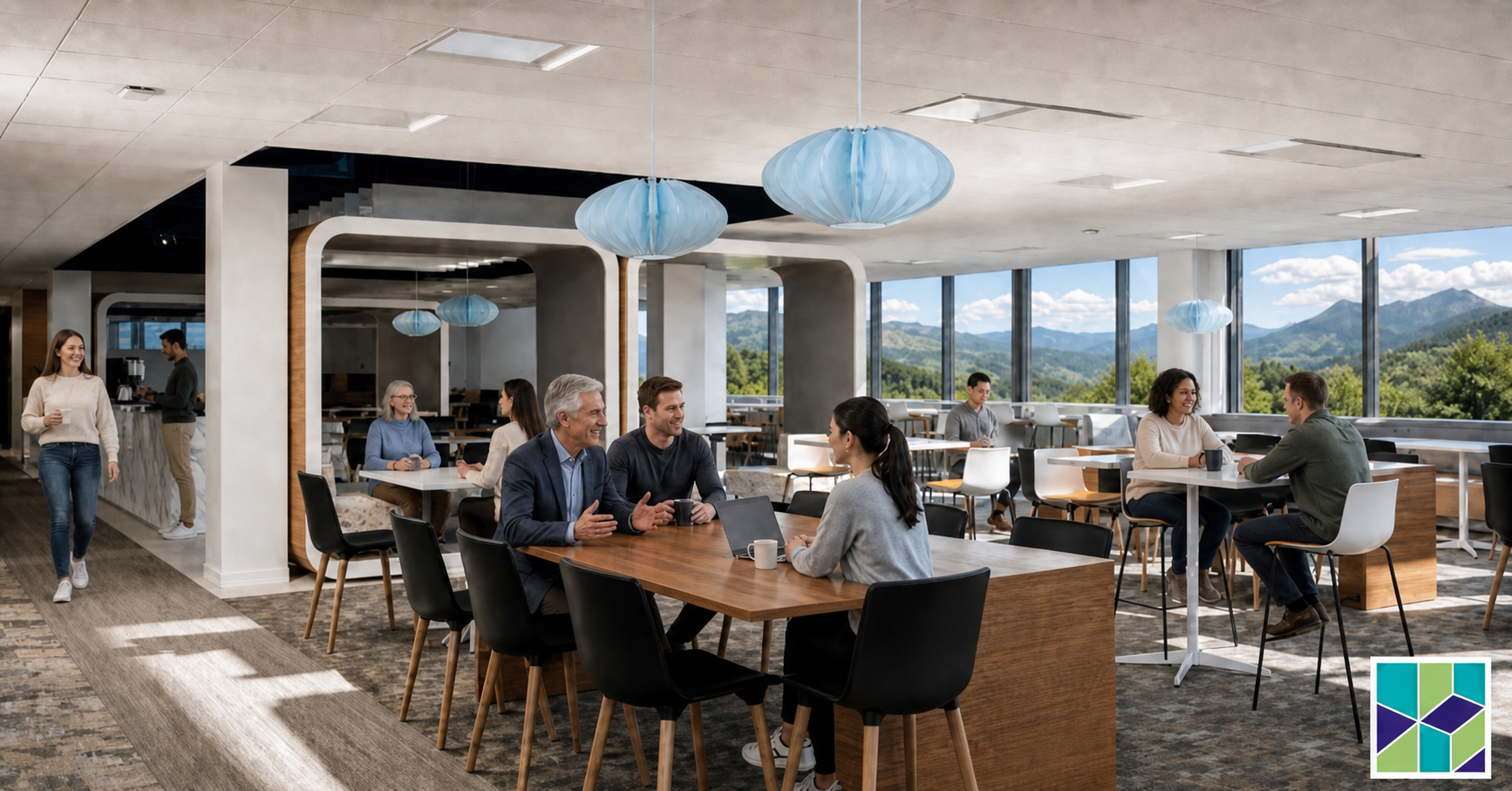

I’m 49. After 17 years out of the workforce raising kids, I came back to an office that felt like a different planet. No more corner offices. No more assigned desks. The whole landscape had shifted.
I re-entered the workforce at a company that specializes in workplace strategy, so I’m always thinking about how our spaces shape us, how they can work for us. We’ve built these gorgeous open floor plans and so-called “neighborhoods”—but let’s be honest, we’ve quietly handed off the hardest part to the employee: find your own comfort.
But what if we flipped that? I don’t want people to hunt for their comfortable spot. I want the spot to shape itself to them.
An idea I can’t stop thinking about
Call it a personalized comfort grid. Microsoft has CoPilot to enhance its workspace – what if facilities managers had PERCH (an as of now completely fictional AI platform).
Picture this: You walk in, plop down at any open seat, and with a password, a badge, maybe even just a wink, the spot becomes yours. The desk rises to your height. The task light warms up the way you like. If you run cold, the air nudges a little warmer. If you’re 26 and want daylight-bright, you get it. Maybe one day, even the scent shifts—green and fresh in the morning, soft and chill after lunch.
No hunting. No thermostat wars. No passive-aggressive sticky notes on the vent. You just sit down, and the building knows you’re there.
Can we actually build this in 2026? Not quite, not like this, anyway. The pieces exist here and there, and sure, some apps let you play with lights and temperature, but that seamless, instant comfort experience? We’re not there yet.
But that’s no reason to stop dreaming about it or talking about it out loud.
Remember the Jetsons
My kids think self-driving cars are boring. A robot that vacuums the floor is a normal thing you get on sale. A video call with someone across the world is how you talk to grandma.
All of that? Pure cartoon magic when I was a kid. But someone had to say the wild idea out loud first, so the people who could actually build it had something to reach for.
That’s how I’ve come to think about pie-in-the-sky workplace design. We are not going to install AI-generated working conditions this year. But if we start throwing ideas around now, we give ourselves the runway to actually be ready when the technology catches up. The firms that will roll out something like a comfort grid in 2027 or 2028 are the ones sketching it on a napkin right now.
So, here’s my version, scribbled on a napkin.
Two things I think are genuinely close
I don’t want to only live in the clouds, so let me put two ideas on the table that I think are realistic inside the next 18 months.
Settings that travel with you. Forget the fancy grid for a minute—just make ergonomics portable. Imagine: height-adjustable desks saving your presets, lights and monitors remembering your setup, and all of it tied to a profile you carry from seat to seat. We’re just stitching together things that already exist. For someone returning to work at 49 with a cranky back (hi, that’s me), for the pregnant colleague, or the six-foot-four engineer who’s tired of folding himself into a standard desk, this isn’t a gimmick. It’s the difference between hurting at 4pm and actually making it through the day.
Climate at the seat instead of the zone. We keep trying to solve comfort for the whole floor, which is doomed—ask ten people about temperature, you’ll get twelve opinions, and at least two are furious. So stop. Give everyone a little local control: an under-desk warmer, a personal air nozzle, a footwarmer, maybe a throw blanket that’s actually designed to be there, not something you sneak in from home. Small, cheap, unglamorous, but it ends the single most common complaint in the office.
Neither of these is futuristic. They’re just about deciding that actual people matter.
Here’s the part I care most about.
We have four generations in the building right now: Boomers are supposedly rigid. Gen X wants to be left alone. Millennials want purpose. Gen Z wants flexibility.
What I actually see, from the inside, is way simpler. My Boomer colleague just wants to read the screen without squinting and not be freezing. My Gen Z teammate doesn’t want to be stuck where four people can see her monitor. My Gen X coworker craves ninety minutes of peace. Me? I want a chair that likes my back and a place I can eat lunch without performing.
None of those are generational values. They’re comfort needs. And they only look like a generational conflict because we’ve been forcing everyone into one averaged-out setting and then acting surprised when nobody’s happy.
Personalization is what dissolves all the drama. When the space adapts to the person, you don’t have to design a compromise that nobody actually likes. We don’t need four different offices for four generations. We just need one office that stops pretending everyone’s the same.
Where I’d start in July (and why August matters, too)
Start your end-of-year planning now, in July or August—not because it’s a box to check off, but because time is your biggest advantage. The earlier you begin, the more room you have to budget, plan, and test ideas before you’re up against deadlines or decision-day pressure. Giving yourself this runway means you can actually think, create, and let big ideas take shape.
Do the two easy things now. Portable ergonomic settings. Local climate control at the seat.
And then, let yourself draw the wild version. The building that knows you. The desk that greets you. The workplace that finally stops asking employees to work around it and starts working around them. Give your team, and yourself, the space to dream, experiment, and build toward something new. You can only do that if you start early enough to actually imagine what’s possible.
We might be a few years out. That’s fine. Somebody had to draw the flying car first.