
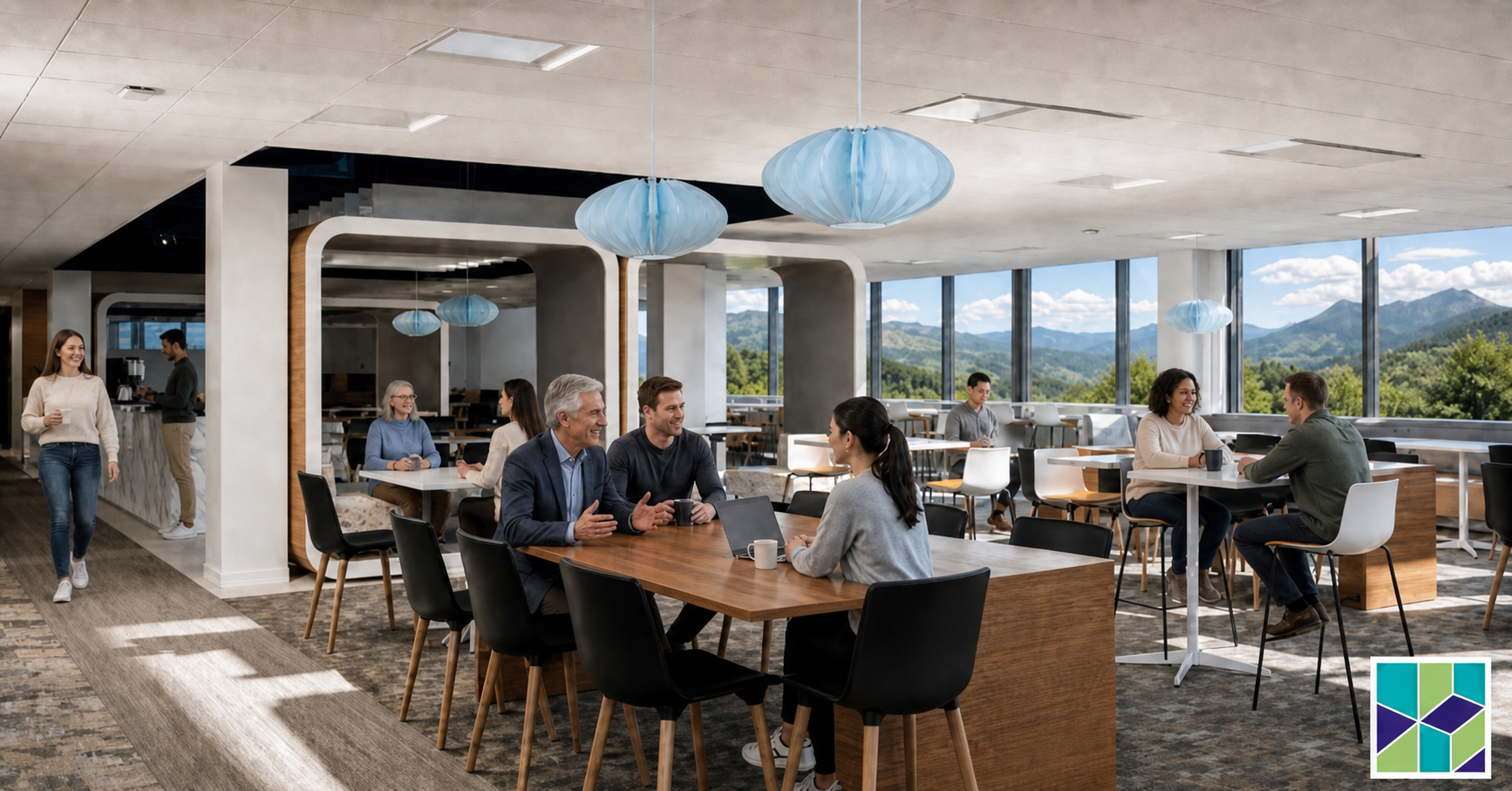

Through my work at HF Planners, I have been exposed to a variety of spaces. A lot of these spaces could be categorized as the “modern workplace” — standing-height collaboration tables, an open plan as far as you can see, a coffee bar with exposed brick, and a few phone booths tucked into the corner. These spaces are visually stunning and make the people managing them proud. The final product cost real money and real effort.
We can play this out by generation. It could be a Gen Xer who’s spent forty minutes commuting for the privilege of being unable to focus. Or a twenty-three-year-old who came in specifically because she wanted to feel less alone, only to discover that the office was designed for everyone except her. Or perhaps it is the Millennial who left behind the comfort of her apartment, her preferred breakfast, and her carefully curated playlist—only to arrive at a space that feels more like a social experiment than a workplace. The undertone, for many, is that “adulting” wasn’t supposed to look like this.
I think about how this space is utilized. How would a woman in her early sixties navigate it? Would she start by circling the floor one or two times, glancing at the phone booths (both occupied), ultimately setting her bag down at a collaboration table, and spending the rest of the time she was there with her back to the room, headphones on, clearly not collaborating with anyone. She had nowhere else to go. She desperately wanted her corner office back.
The problem isn’t that we don’t know who’s in the building. We do. The problem is that we keep designing for only one of them.
The Generation That Showed Up First
Baby Boomers now make up roughly 15% of the workforce, and according to Gallup workplace data, they are still among the most likely to work primarily on-site, with significantly lower rates of fully remote work than younger cohorts. They are, by the numbers, the most physically present generation we have. They also carry institutional knowledge that organizations cannot quantify until it walks out the door.
What I’ve found working with this group is that they don’t need the office to be exciting. They need it to be excellent. An assigned workstation, not a hoteling lottery. Task lighting that doesn’t require a twenty-minute ergonomic negotiation. Private spaces for focused, heads-down work. These are not perks. For someone who has been doing meaningful work for thirty-plus years, a supportive environment is the baseline.
When we shortchange that, we’re not saving space. We tell them, with furniture, that they’re on the way out.
The Generation Nobody Is Asking About
Here’s a statistic that stopped me cold: according to a 2024 report from the U.S. Census Bureau and Kauffman Foundation, the highest rate of new business formation is now among people aged 45–54 — squarely Gen X. The generation that is supposed to be “in the middle” is, in practice, running everything — and doing it while managing aging parents, raising teenagers, and hitting the most demanding years of their careers simultaneously.
Research shows that Gen X reports the highest average stress levels of any generation, yet SHRM data indicates they are among the least likely to feel supported by workplace wellness programs.
They are also the generation most likely to leave without telling you why. No exit interview drama, no LinkedIn post about culture. They just go.
What they need from a physical environment is simple, and it’s not perks: frictionless hybrid technology, focus rooms they can get into without booking three days in advance, and absolutely no surveillance design. The open plan with the manager’s glass office facing the floor? They know what that is. They’ve been in the workforce long enough to recognize a panopticon when they sit in one, and they don’t like it.
The Generation That Built the Open Plan and Now Hates It
Millennials make up the largest share of the workforce, and they are largely the reason we have the environments we have. They drove the open-plan revolution. They wanted collaboration, connection, energy.
A decade later, many are reassessing. Deloitte’s 2024 Gen Z and Millennial Survey found that nearly one in three Millennials report high levels of stress, and workplace environment plays a measurable role in that experience. At the same time, McKinsey research shows that employees increasingly link their physical workplace to overall well-being and job satisfaction.
Additional data indicates that employees who feel their workplace supports well-being are significantly more likely to stay with their employer, a signal that space is no longer just overhead.
What this group needs now isn’t a reversal, it’s nuance. Biophilic elements, materials that feel warm and considered rather than clinical, and access to quiet retreat options alongside real social infrastructure. Millennials want spaces that feel cared for because, for this generation more than most, the quality of space is a direct proxy for how valued they believe themselves to be.
The Generation That Actually Wants to Come In
Gen Z’s preferences have surprised some of our clients. According to a 2025 Deloitte report, many Gen Z workers say they prefer at least some in-person work, citing connection, mentorship, and learning as key drivers. Pew Research data similarly shows that younger workers are more likely to value the social and developmental aspects of being physically present.
And yet, many are underwhelmed by what they find when they get there.
They are the most socially motivated generation in the building, and the most sensory-aware. They want acoustic zones that work, circadian lighting that isn’t just a pitch-deck feature, and materials that reflect visible Environmental, Social & Governmental commitments. They have grown up in a world saturated with corporate performance and they can tell immediately when sustainability is a wall graphic versus a real decision. And they are looking for psychological safety in the physical environment itself: spaces that signal you can make a mistake, ask a question, not have everything figured out yet.
What Every Generation Actually Has in Common
The loneliness data is what pulls me up short every time I look at it. The U.S. Surgeon General’s advisory on loneliness and isolation identifies it as a widespread public health issue affecting workers across all age groups. Gallup research echoes this, showing that a significant portion of employees report feeling disconnected at work, regardless of generation.
At the same time, McKinsey data suggests that only a small percentage of employees want a fully traditional, five-day office experience. What people want instead is choice, and environments that justify the commute.
The multi-generational office is not a design problem that gets solved with a single furniture plan or a clever amenity package. It is a layered, intentional environment that asks each group what they need to do their best work and takes the answer seriously. That means acoustic choice, not acoustic aesthetics. It means technology that works before someone from IT must come to look at it. It means materials, light, and air quality that signal someone made a real decision about this place.
I’ve been in enough buildings where nobody made that decision. I’ve watched the woman in the headphones circle the floor. I know what it costs, not in real estate terms, but in human terms that don’t show up until a departure report arrives six months too late.
The office was never built for all of us. But it can be. That’s the challenge.